
Many DeFi users assume that a wallet is just a signing tool: click approve, and the network will sort out the rest. That assumption — that transactions are binary events whose outcomes are either “succeeded” or “failed” and only on-chain history matters — is wrong in practice. In complex smart-contract interactions, front-running, reentrancy, gas racing, slippage, and incorrect calldata can turn a single click into a loss. The practical remedy isn’t superstition or blind diversification; it’s instrumenting your wallet to simulate transactions, track portfolio exposure continuously, and surface conditional risks before you sign.
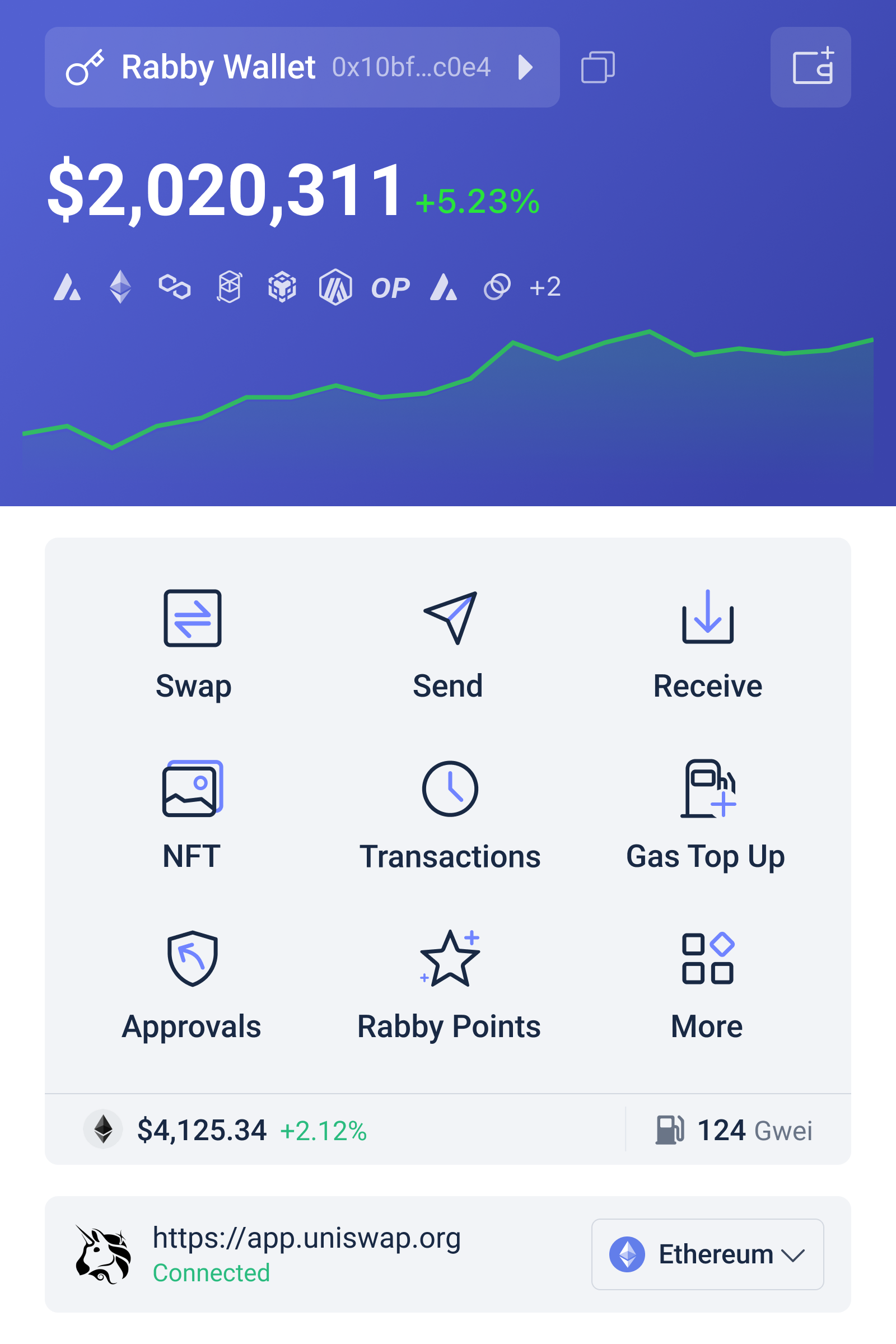
This article explains the mechanisms of transaction simulation, portfolio tracking, and risk assessment in a modern EVM wallet; clarifies common myths; compares trade-offs; and gives decision-useful heuristics you can use now as a US-based DeFi participant. I’ll also point to a concrete, user-facing place to try these features in your browser wallet: https://rabby-wallet.at/.
How transaction simulation works — the mechanism you need to understand
Transaction simulation is the practice of executing a transaction locally or against a node in “dry-run” mode before broadcasting it to the mempool. Mechanically, a simulator constructs the same calldata, gas limit, and value as the intended broadcast, then runs it through an EVM instance that is fed a recent snapshot of chain state: token balances, contract storage, pending receipts, and sometimes mempool transactions. The result is an execution trace that shows whether the tx would revert, how much gas it would consume, token transfers, and changes to storage.
This matters because many failure modes are invisible until they happen: a contract throws an error due to changed state, a required approval is missing, a swap route is stale, or a flash-loan-based exploit could be triggered by an unexpected state change. Simulation gives you counterfactuals: what will happen given the current chain state. It does not — and cannot — predict future mempool contention or miner behavior, but it reduces a wide class of avoidable errors.
Portfolio tracking: what to measure, and how it feeds risk decisions
Portfolio tracking is often treated as a cosmetic feature: a pretty dashboard of balances and prices. In practice, it must be tightly coupled to transaction simulation and to live state feeds. Useful measures include: on-chain free float (tokens immediately transferable vs. timelocked), unrealized protocol-level exposures (open loans, collateral ratios), token-level liquidity depth (how much slippage a market order would generate), and concentration metrics (top assets vs. the rest). When tracking is decoupled from transaction context you lose the ability to estimate post-trade exposure — which is exactly when risk matters most.
For example, swapping a small stablecoin position into a thinly traded governance token might look harmless as a balance change, but combining a simulation that calculates slippage against pool depth and a tracking view that shows the token will jump to 30% of your portfolio after the trade reframes the decision. That coupling — simulation plus tracking — is where modern wallets add real decision value.
Risk assessment: signal types, limits, and practical heuristics
Risk assessment in DeFi is probabilistic and layered. Useful signals include deterministic failures (reverts), economic risks (slippage, sandwich attacks), counterparty risks (protocol insolvency, oracle manipulation), and operational risks (lost private keys, malicious approvals). Crucially, not all signals are equally actionable from the wallet: deterministic simulation failures are high-confidence rejections; slippage estimates are conditional on liquidity and timestamp; oracle risk is a systemic category that simulation only approximates.
Three practical heuristics to use now:
- Never sign an approval that grants “infinite” allowance to unfamiliar contracts. Simulate the approving tx and check the contract’s verified source if possible.
- Treat estimated slippage >1–2% in small-cap token swaps as a red flag; simulate across different gas-price and mempool conditions if the trade is time-sensitive.
- For leveraged positions or loan interactions, always simulate the entire workflow (open, adjust, close) to observe collateral ratio changes and gas tail risks.
These are rules of thumb, not guarantees. The simulation environment mirrors a snapshot; it cannot see future MEV activity nor predict a zero-day vulnerability in a protocol you interact with. But it does remove low-hanging errors and clarifies economic exposure.
Common myths vs. reality
Myth: “Simulation is full-proof — if it passes, I’m safe.” Reality: Simulation reduces but does not eliminate risk. It cannot foresee mempool adversarial actions, off-chain oracles updates, or changes in miner/validator inclusion patterns after you submit the transaction.
Myth: “Portfolio trackers are vanity metrics.” Reality: When integrated with simulation and action-context, trackers reveal conditional exposures (e.g., how a gas spike would force liquidation). The value is in the predictive scenario: not just what you own now, but what you will own if this or that transaction finalizes or if a market move occurs.
Trade-offs: UX, privacy, and trust
Implementing local simulation and continuous tracking requires trade-offs. Local simulation (running an EVM client in the browser extension) increases privacy because it avoids sending full transaction data to remote services, but it raises resource and complexity costs. Remote simulation services are lighter on the client, but they require trust and expose inputs to another party. Similarly, deep portfolio tracking that queries many contract states increases RPC load and can reveal patterns if shared with third parties.
For US users, regulatory and privacy considerations also matter: avoid over-sharing private data to third-party analytics unless you understand their retention policies. Wallets that keep computations client-side and only fetch necessary public state strike a reasonable balance for most users.
Decision-useful framework: three-step routine before every significant DeFi action
Here’s a compact routine that translates the mechanisms above into consistent behavior:
- Simulate the transaction exactly as you plan to send it — not a simplified version. Observe reverts, gas, and token flows.
- Run the implied portfolio delta through your tracker: will the trade increase concentration, lower collateral ratios, or create new counterparty dependencies?
- Assess residual risks: what would change if gas spikes, if a mempool attacker reorders, or if an oracle updates? If any residual risk is unacceptable, back out or split the operation into chunks and re-simulate.
This routine clarifies choices and makes the trade-offs explicit rather than implicit.
What to watch next — conditional signals and trends
Two near-term signals that matter for wallet users in the US: growing sophistication of MEV strategies and tighter integration of wallet-based simulation features with DEX aggregators. If MEV tooling becomes harder to detect in the mempool, wallets that provide fast, local simulation and gas-price path analyses will have comparative advantage. Conversely, if on-chain simulators move to remote services for speed, users should demand transparency about data retention and reuse.
Also monitor how wallets present risk to users: clear, actionable warnings beat alarmist alerts. The best tools will explain the specific mechanism of danger (e.g., oracle lag creates liquidation risk) rather than produce generic “risky” labels.
FAQ
Does simulation guarantee my trade won’t be front-run or sandwiched?
No. Simulation shows what happens against a snapshot of state; it cannot predict adversarial ordering or subsequent mempool activity. However, simulation can show if a trade is highly sensitive to slippage or has a narrow margin that makes front-running economically attractive — which is actionable intelligence.
How often should I refresh portfolio tracking data?
Frequency depends on activity: casual holders can refresh on demand or hourly; active traders and liquidity providers should use near-real-time updates (seconds to minutes) for balances, open orders, and collateral ratios. Balance that frequency with privacy and RPC-cost considerations.
Is client-side simulation better than remote services?
Neither is universally better. Client-side simulation offers privacy and control but may be slower or heavier on device resources. Remote services are faster and can offer enriched analytics, but they introduce trust and data exposure trade-offs. Choose based on threat model: if you value privacy and independence, favor local processing;
Will these tools stop smart-contract exploits?
No. Simulations can detect some exploitable states (e.g., insufficient balance checks) but not unknown vulnerabilities or off-chain coordination. They are risk-reduction tools, not guarantees.